Decree 28,049/2025 (Complementary Law No. 482/2014)
Sustainability incentive law
Law 10,501/2019
Goal of 90% by 2030
Less volume
of stored waste
the sizing
The calculation no one did in your project
The waste volume calculation, required to approve the project, defines how many waste bins and how much service area the project needs.
Food-related organic waste is not non-recyclable waste. It is a potential resource that Reatto treats at the source.
Without Reatto
Higher pest control costs Concern over collection stoppages Larger service area required
With Reatto
Less service area set aside for waste bins No more bad odor or attraction of insects and pests Waste treated where it is generated, with value returned
the six benefits
What the building gains
Smaller service area
Fewer waste bins in the sizing, more area available for the project.
Added value per m²
An Abrainc + Brain study estimates up to 10% more in the value of the square meter.
Legal compliance
Law 10,501/2019: goal of diverting 90% of organic waste by 2030.
Green IPTU pathway
On-site treatment earns points in Green IPTU and sustainable construction programs.
Eases certifications
Helps earn points in LEED and AQUA-HQE, the most widely adopted in Brazil.
Developers say
58% see ESG value in the m² and 53% believe buyers pay more (Abrainc + CTE).
Simple and compact
Simple installation, energy efficiency in operation
specifications
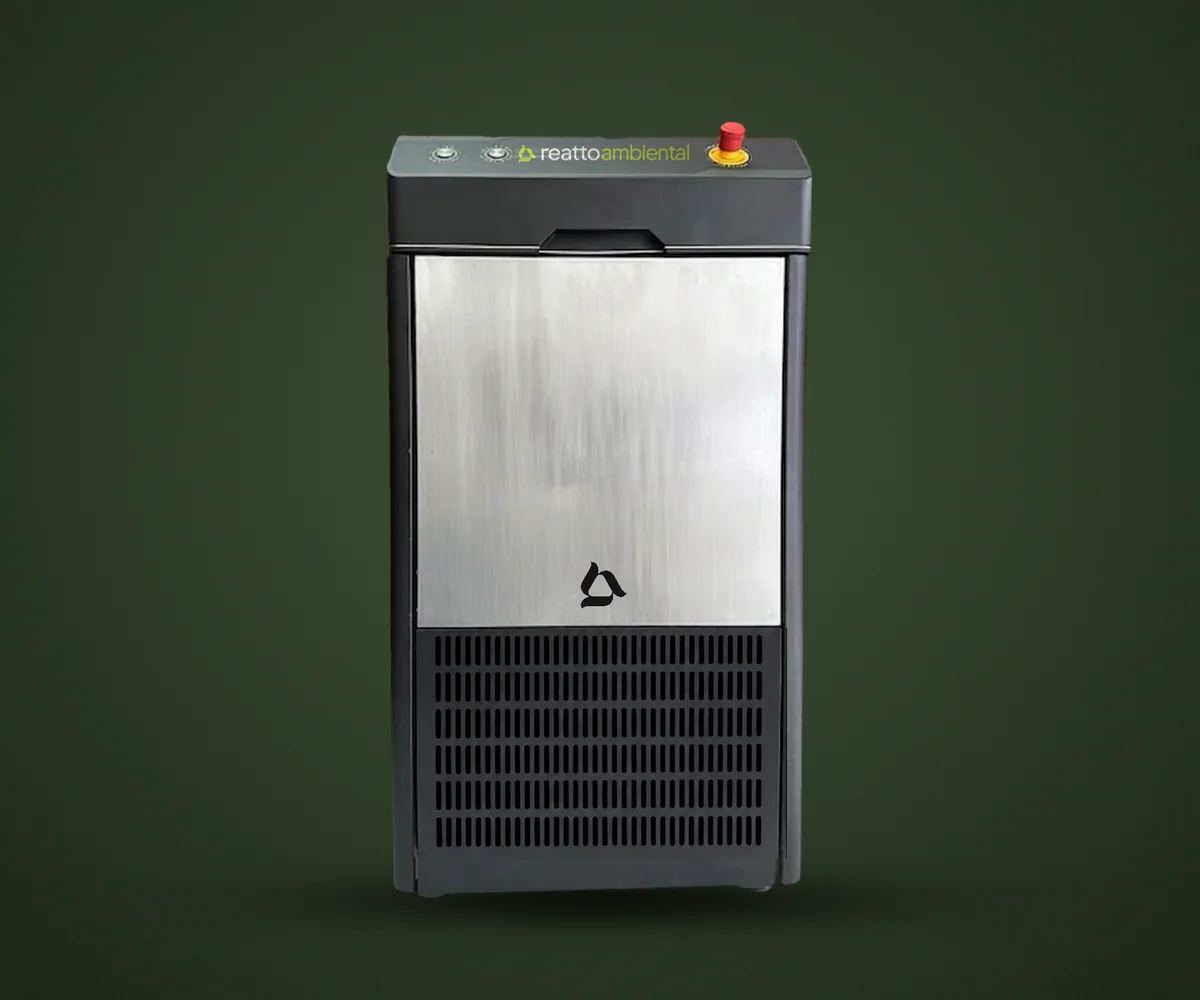
Unit specifications
The waste volume calculation for each building is the basis for sizing the number of units needed to meet demand. Reatto performs this calculation, designs and defines all the required infrastructure, at no cost.
Up to 50 kg of food waste per day
Controlled reduction
220V single-phase and Wi-Fi connection
Enclosed, covered, ventilated service area
from plate to plate
And in the end, there's the part that doesn't fit in a spreadsheet
All organic waste that leaves the building becomes methane in the landfill. Treated on site, it becomes fertilizer and returns to the soil.