How can people and companies work together for the circular economy?

Understand why joining hands matters if we want to build a more circular world together!
The circular economy is a concept that seeks to break away from the traditional linear model of production and consumption, in which natural resources are extracted, turned into products and then discarded as waste. Instead, the circular economy proposes a more sustainable model, in which products are designed to be durable, recyclable and able to re-enter the production cycle, reducing waste and environmental impact.
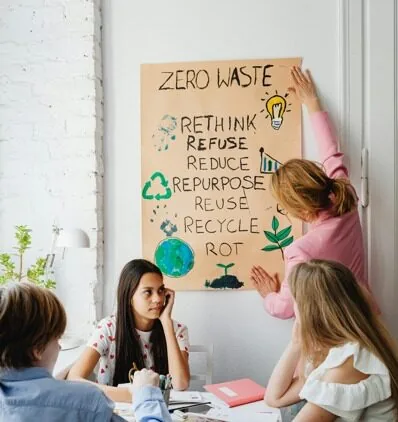
The diagram below shows, in practical terms, the circular economy concept applied to our daily lives. The circular economy process itself has several definitions but, in general, it is based on the 5R’s: refuse, rethink, reduce, reuse and recycle.

Looking at the chain as a whole, which involves industries, users and government organizations, it is clear that for the circular economy to become a reality, everyone must get involved and work together to achieve truly efficient results. That is why, in this article, we explore how people and companies can work together for the circular economy by adopting sustainable practices that benefit the environment and society as a whole.
Awareness and education
Awareness is the first step toward promoting the circular economy. People and companies need to understand the negative impacts of the linear production model and how their actions can contribute to the transition to a more circular economy. It is essential to spread information about the benefits and opportunities this economy offers.
Investing in sustainability education is essential to enable individuals and organizations to adopt more sustainable practices in their production and consumption processes. Schools, universities and institutions can include the circular economy in their curricula, training professionals who are prepared to handle the challenges and opportunities of this economic approach.
Part of what Reatto does when it creates and shares articles like this one with you is to facilitate environmental education. We strongly believe in the power of knowledge to achieve great sustainable results.
Collaboration and partnerships
Collaboration between companies and communities is essential to promote the circular economy. One way to do this is for companies to build partnerships with local communities to create joint solutions to the challenges they face. Through social responsibility programs and engagement initiatives, it is possible to involve citizens in the life cycle of products, encouraging selective collection, recycling and reuse of materials.
Thinking about the post-purchase stage, many types of business show how partnerships between consumer and producer can lead to improvement, and e-commerce is one of them. The amount of paper, cardboard and plastic used to ship products sold online is already considerable today, and since this is a market that grows significantly every year, its environmental responsibility grows even more. That is because the most common path for this material is for the consumer to receive products in many layers of packaging and then throw all of it away, since it no longer has any use. Inside and outside e-commerce, there is also the case of clothing: do you know how to dispose of a used garment? And how can you tell it has no more use or chance of being reused? If you have never heard about it, the Atacama Desert is a great example of how we do not know how to deal with this type of waste. Check out a BBC report on the topic >by clicking here.
Besides building partnerships, creating sustainable business networks is another way to promote the circular economy. Companies from different sectors can join forces to exchange knowledge, share resources and look for innovative solutions that reduce waste and maximize the use of materials.
Innovation and technology
Innovation plays a key role in the transition to a more circular economy. Investing in research and development of sustainable, durable and repairable products is a cornerstone of this new economic model. It is also important to explore new technologies that can optimize production processes, reduce the use of natural resources and make recycling easier.
Information technology can also be a great ally of the circular economy. Traceability, for example, makes it possible to monitor the life cycle of products, from the extraction of raw materials to final disposal. This allows more efficient resource management and makes it easier to implement sustainable practices across the entire production chain.
In short, the circular economy offers a new paradigm for sustainable production and consumption. People and companies have a key role in this transition, and countless solutions can be created. All it takes is to discuss and put into practice more conscious and collaborative actions that align with our long-term sustainability goals.
Still have questions? Just leave a comment on this post and we will help you!
Follow us on >social media and check out more great content we regularly share about the environment, composting, business and sustainable partnerships.
Main image source: Parradee Kietsirikul